
Liquid Manufacturing Plant for Pharmaceutical Production
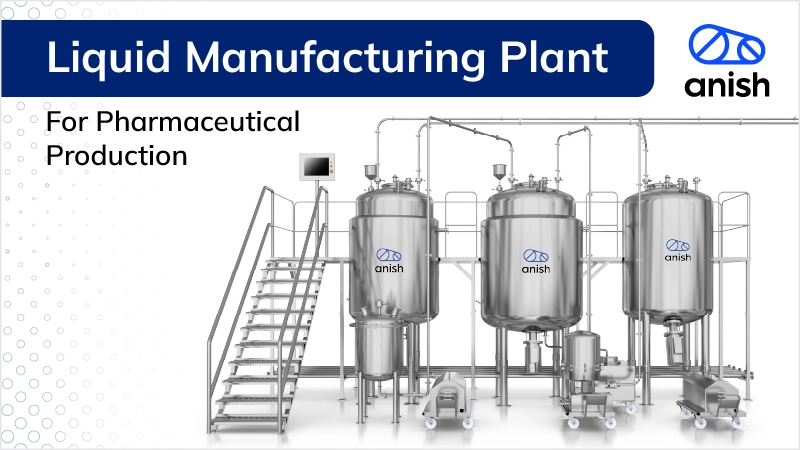
Pharmaceutical liquid formulations require controlled mixing, dissolution and handling to achieve consistent product quality across batches.
An integrated Liquid Manufacturing Plant brings together preparation, mixing, filtration, storage, transfer and process control within a hygienic and coordinated manufacturing system.
Solution Preparation & Mixing
Ingredients are added to the manufacturing vessel under controlled agitation to achieve uniform dissolution and mixing.
The mixing system is selected based on:
- Product viscosity
- Batch size
- Mixing intensity
- Dissolution requirements
- Formulation characteristics
Proper mixing helps achieve consistent concentration and uniform product characteristics throughout the batch.
Heating & Cooling
Many liquid formulations require controlled heating during dissolution or preparation, followed by cooling before further processing or filling.
Jacketed vessels and temperature-control systems help maintain the required process conditions throughout the batch.
Filtration
Filtration can be incorporated before product transfer or filling to remove unwanted particles and achieve the required product clarity.
The filtration system is selected according to the formulation, process requirements and required filtration level.
Product Holding & Transfer
After preparation, the finished liquid can be transferred to a holding vessel or directly to the filling line.
Closed product-transfer systems help:
- Reduce contamination risk
- Minimise manual handling
- Reduce product exposure
- Support hygienic processing
- Improve transfer efficiency
Cleaning & Hygienic Design
Efficient cleaning is essential for maintaining product quality and reducing cross-contamination risk.
The system can be designed with:
- Hygienic product-contact surfaces
- Drainable piping
- Reduced product hold-up
- WIP provisions
- Easy access for cleaning and inspection
Automation & Process Control
Automation enables monitoring and control of important process parameters such as:
- Recipe management
- Mixing speed
- Temperature
- Process time
- Alarms & interlocks
Integrated controls help improve batch-to-batch consistency, repeatability and operational reliability.
An effective Liquid Manufacturing Plant brings together Mixing, Dissolution, Temperature Control, Filtration, Product Transfer, Cleaning and Automation within one coordinated process.
Anish manufactures customized Liquid Manufacturing Plants based on formulation characteristics, batch size, process requirements and production capacity.
Backed by 35+ years of experience and installations across 30+ countries, Anish supports pharmaceutical manufacturers in developing reliable and scalable liquid manufacturing processes.
Other Blogs
- Ointment Manufacturing Plant for Pharmaceutical Production
- Fluid Bed Technology for Nutraceutical Manufacturing
- Extruder & Spheroniser for Pharmaceutical Pelletisation
- API Reactor Charging Isolators: Improving Operator Safety During Reactor Charging
- Top Spray Fluid Bed Granulator
- Role of Isolators in Pharma Manufacturing
- Fluid Bed Wurster Technology for Nutraceutical Applications
- Fluid Bed Coater for Pharma Manufacturing
- When Should You Retrofit Pharmaceutical Equipment?
- Top Challenges in Granulation Process and How to Solve Them
- Top 10 Pharmaceutical Equipment Used in Tablet & Capsule Manufacturing
- Things to Consider Before Buying Granulation Equipment
- Integrated Granulation Line (Closed Loop Granulation Line) in Pharmaceutical Manufacturing
- How Automation is Changing Pharmaceutical Manufacturing in India
- Fluid Bed Dryer vs Fluid Bed Coater
- Containment Systems in Pharma Manufacturing (OEB Levels Explained)
- Role of Preformulation Parameters in Pharmaceutical Dosage Forms Manufacturing
- Equipment Capacity and Airflow Management for Successful Fluid Bed Coating Scale-Up
- What is granulation? Why do we need it? And what’s the best place to carry it out?
- What is a Fluidized Bed Dryer?
- The Heart and Soul of the Pharmaceutical Industry: Materials & Machines
- Temperature and Humidity: Critical Factors in Fluid Bed Processing
- Mastering Pellets Manufacturing: The Role of QTPP and QbD
- Importance of Solvent Systems in Pharmaceutical Pellets Coating
- Guide to Optimal Fluid Bed Processor Selection: Key Considerations for Effective Material Processing
- Fluid Bed Performance Drivers
- Influence of Column Diameter and Partition Gap on Scale-Up of Bottom Spray Fluid Bed Coaters
- Critical Process Parameters Influencing Performance in Fluid Bed Systems
- Critical Factors for Scale-up in Bottom Spray Fluid Bed Coating
- Binders and Solvents in Granulation
- Types of Granulation in Pharma Manufacturing
- Granulation Techniques To Create Robust Formulation
- Unleashing the Power of Fluid Bed Technology: A Comprehensive Guide
- Pharmaceutical Pellet Production Techniques
- Pharma Granulation: From Powders to Perfect Granules
- Improving Productivity of Fluid Bed Processors
- Drug layering technique in pellet formation
- Drug delivery technologies in Pharmaceutical Formulations
- How to Choose the Right Pressure Shock Resistance (2 / 12 BAR) for Your Fluid Bed Processor