
Things to Consider Before Buying Granulation Equipment
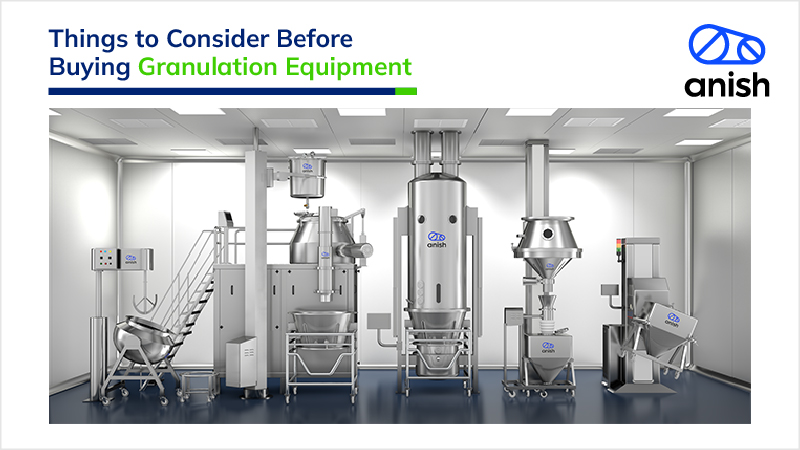
Granulation is a critical step in pharmaceutical manufacturing because it directly affects tablet quality, flowability, compressibility, and uniformity of active ingredients. Selecting the right granulation equipment is therefore an important decision for pharmaceutical manufacturers.
Before investing in granulation equipment such as Rapid Mixer Granulators, Fluid Bed Granulators, or integrated granulation lines, manufacturers should carefully evaluate several technical and operational factors. The right selection improves process efficiency, product quality, and long-term operational reliability.
- Type of Granulation Process
The first step is to determine the type of granulation process required for your product.
Common granulation processes include:
- Wet Granulation – widely used for pharmaceutical tablets using binder solutions.
- Dry Granulation – suitable for moisture-sensitive or heat-sensitive materials.
- Fluid Bed Granulation – combines granulation and drying in a single system.
The equipment selection should align with the formulation characteristics and manufacturing process.
- Product Characteristics
Understanding the properties of the formulation is essential before selecting granulation equipment.
Important factors include:
- Particle size and flow properties
- Sensitivity to moisture or heat
- Binder requirements
- API distribution and uniformity
Certain formulations require high-shear granulation, while others perform better with fluid bed granulation.
- Batch Size and Production Capacity
Manufacturers must evaluate the required batch size and production volume before purchasing equipment.
Key considerations include:
- Current production capacity
- Future production expansion
- Number of batches required per day
Selecting equipment with appropriate capacity ensures optimal productivity without overloading the system.
- Integration with other Equipment
Granulation equipment should integrate smoothly with other systems in the production line.
Typical upstream and downstream equipment includes:
- Raw material dispensing systems
- Rapid mixer granulators
- Fluid bed dryers
- Milling equipment
- Tablet compression machines
Proper integration helps create a continuous and efficient manufacturing workflow.
- Cleaning and Changeover Time
In pharmaceutical manufacturing, equipment must be easy to clean to prevent cross-contamination.
Important aspects to evaluate:
- Wash-In-Place (WIP) capability
- Easy access for manual cleaning
- Quick dismantling of product contact parts for cleaning
- Reduced changeover time
Efficient cleaning systems help manufacturers maintain GMP compliance and production efficiency.
- Process Control and Automation
Modern pharmaceutical equipment increasingly includes advanced automation systems.
Look for features such as:
- PLC or SCADA-based control systems
- Real-time monitoring of process parameters
- Recipe management
- Batch data recording
Automation improves process consistency, traceability, and operational control.
- Compliance with Regulatory Standards
Pharmaceutical granulation equipment must comply with industry standards.
Important certifications and guidelines include:
- CGMP compliance
- FDA guidelines
- 21 CFR Part 11 compliance
- Documentation and validation support
Proper regulatory compliance ensures the equipment is suitable for pharmaceutical manufacturing environments.
- Maintenance and Service Support
Long-term reliability of equipment depends on maintenance and technical support.
Before purchasing equipment, evaluate:
- Availability of spare parts
- Service response time
- Technical & Process support and training
- Preventive maintenance programs
Reliable service support minimizes downtime and production interruptions.
- Energy Efficiency and Operating Cost
Granulation equipment should also be evaluated based on operational cost and energy consumption.
Efficient systems help reduce:
- Utility consumptions like. Power, Compressed Air, Chilled Water etc.
- Manpower cost
- Processing time
Lower operating costs improve the overall profitability of manufacturing operations.
Selecting the right granulation equipment requires careful consideration of process requirements, product characteristics, production capacity, and regulatory compliance. By evaluating these factors, pharmaceutical manufacturers can ensure efficient production, consistent product quality, and long-term operational reliability.
Anish pharma helps pharma manufacturers select the most suitable granulation technologies based on their process requirements, formulation characteristics, and production scale. With 35+ years of expertise in pharmaceutical process equipment, the company delivers reliable solutions that support efficient and consistent pharmaceutical manufacturing.
Other Blogs
- Ointment Manufacturing Plant for Pharmaceutical Production
- Liquid Manufacturing Plant for Pharmaceutical Production
- Fluid Bed Technology for Nutraceutical Ingredients
- Extruder & Spheroniser for Pharmaceutical Pelletisation
- API Reactor Charging Isolators: Improving Operator Safety During Reactor Charging
- Top Spray Fluid Bed Granulator
- Role of Isolators in Pharma Manufacturing
- Fluid Bed Wurster Technology for Nutraceutical Applications
- Fluid Bed Coater for Pharma Manufacturing
- When Should You Retrofit Pharmaceutical Equipment?
- Top Challenges in Granulation Process and How to Solve Them
- Top 10 Pharmaceutical Equipment Used in Tablet & Capsule Manufacturing
- Integrated Granulation Line (Closed Loop Granulation Line) in Pharmaceutical Manufacturing
- How Automation is Changing Pharmaceutical Manufacturing in India
- Fluid Bed Dryer vs Fluid Bed Coater
- Containment Systems in Pharma Manufacturing (OEB Levels Explained)
- Role of Preformulation Parameters in Pharmaceutical Dosage Forms Manufacturing
- Equipment Capacity and Airflow Management for Successful Fluid Bed Coating Scale-Up
- What is granulation? Why do we need it? And what’s the best place to carry it out?
- What is a Fluidized Bed Dryer?
- The Heart and Soul of the Pharmaceutical Industry: Materials & Machines
- Temperature and Humidity: Critical Factors in Fluid Bed Processing
- Mastering Pellets Manufacturing: The Role of QTPP and QbD
- Importance of Solvent Systems in Pharmaceutical Pellets Coating
- Guide to Optimal Fluid Bed Processor Selection: Key Considerations for Effective Material Processing
- Fluid Bed Performance Drivers
- Influence of Column Diameter and Partition Gap on Scale-Up of Bottom Spray Fluid Bed Coaters
- Critical Process Parameters Influencing Performance in Fluid Bed Systems
- Critical Factors for Scale-up in Bottom Spray Fluid Bed Coating
- Binders and Solvents in Granulation
- Types of Granulation in Pharma Manufacturing
- Granulation Techniques To Create Robust Formulation
- Unleashing the Power of Fluid Bed Technology: A Comprehensive Guide
- Pharmaceutical Pellet Production Techniques
- Pharma Granulation: From Powders to Perfect Granules
- Improving Productivity of Fluid Bed Processors
- Drug layering technique in pellet formation
- Drug delivery technologies in Pharmaceutical Formulations
- How to Choose the Right Pressure Shock Resistance (2 / 12 BAR) for Your Fluid Bed Processor