
Fluid Bed Coater for Pharma Manufacturing
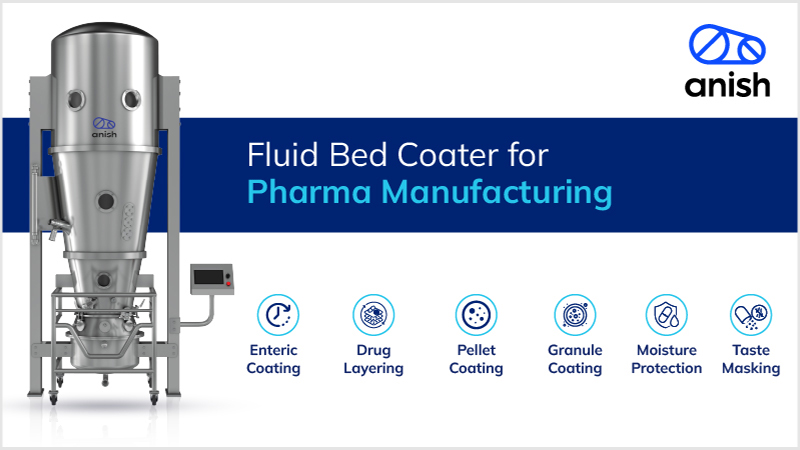
In pharmaceutical manufacturing, coating is not only about appearance. It plays a critical role in product performance, stability, taste masking, controlled release, moisture protection and patient compliance. As dosage forms become more complex, manufacturers need coating systems that can deliver uniform results, process flexibility and reliable scale-up.
A Fluid Bed Coater is one of the most effective technologies used in pharma processing for coating particles, granules, pellets, and multi-particulate systems. It combines fluidization, drying and spraying in a controlled environment to achieve uniform coating and consistent product quality.
What is a Fluid Bed Coater?
A Fluid Bed Coater is a processing system in which particles are suspended in a stream of controlled air while a coating solution or suspension is sprayed onto them. As the particles move continuously, the coating material gets deposited uniformly on the surface and dries almost immediately.
Depending on the application, Fluid Bed Coaters can be designed with different spray configurations such as top spray, bottom spray Wurster and tangential spray. Each configuration supports different process requirements such as granulation, film coating, pellet coating, taste masking, enteric coating and controlled release.
Importance of Fluid Bed Coating in Pharma
Pharmaceutical ingredients and dosage forms often require protection from moisture, gastric environment, light or interaction with other ingredients. Fluid Bed Coating helps create a functional layer around the product, improving its stability, performance and manufacturability.
It is widely used for coating pellets, granules and active pharmaceutical ingredients where uniform coating and controlled process conditions are essential. The technology is especially important for modified release products, multi-particulate dosage forms and taste-masked formulations.
Key Applications of Fluid Bed Coater in Pharma
- Pellet Coating
Fluid Bed Coaters are commonly used for coating pellets with functional or protective layers. These coated pellets can be filled into capsules or compressed into tablets. - Taste Masking
Many APIs have bitter or unpleasant taste. Fluid bed coating helps create a barrier layer that reduces taste perception and improves patient acceptability. - Controlled Release Coating
Fluid Bed Coaters are used to apply release-controlling polymers that help achieve sustained release, delayed release or targeted release profiles. - Enteric Coating
For drugs that need protection from stomach acid or should release in the intestine, fluid bed coating can be used to apply enteric coating on pellets or granules. - Moisture Protection
Moisture-sensitive APIs and excipients can be coated to improve stability during storage and further processing. - Drug Layering
Fluid bed systems can be used for drug layering, where active material is deposited onto inert cores or starter pellets. - Granule Coating
Granules can be coated to improve flowability, reduce dusting, modify release or improve downstream processing.
Advantages of Fluid Bed Coater
A well-designed Fluid Bed Coater offers several advantages to pharmaceutical manufacturers:
- Uniform and controlled coating
- Efficient drying during the coating process
- Better process consistency
- Reduced product handling
- Suitable for functional and protective coating
- Improved product stability
- Flexible use across pellets, granules and particles
- Scalable from lab to commercial production
- Better control over critical process parameters
Critical Process Parameters
Fluid Bed Coating requires careful control of process parameters. Key parameters include inlet air temperature, product temperature, air volume, spray rate, atomization air pressure, coating solution viscosity, nozzle position, drying efficiency and batch load.
Improper control can lead to issues such as agglomeration, uneven coating, poor yield, nozzle blockage or inconsistent release profile. Therefore, equipment design, automation, process understanding and trial-based optimization are important for successful pharma coating.
Role of Wurster Coating
For highly uniform coating of pellets and multi-particulates, bottom spray Wurster technology is widely preferred. In this system, particles move through a Wurster column in a controlled cyclic pattern, allowing each particle to receive a uniform coating layer.
Wurster coating is especially useful for modified release pellets, enteric coating, taste masking, drug layering and functional coating applications where precision is critical.
Why Equipment Design Matters
In pharma coating, equipment design directly affects product quality and process repeatability. Air distribution, expansion chamber design, filter system, spray nozzle arrangement, bowl geometry, cleaning access, automation and safety features all contribute to process performance.
A reliable Fluid Bed Coater should support consistent fluidization, efficient drying, accurate spray control, easy cleaning, process monitoring and scale-up from development to production.
Fluid Bed Coaters have become an important part of modern pharmaceutical processing. They help manufacturers improve coating uniformity, product stability, release performance and overall process consistency.
For pharma companies developing coated pellets, granules, taste-masked APIs or controlled-release formulations, a well-designed Fluid Bed Coater provides the flexibility, precision and scalability required for reliable production.
Anish Pharma designs and manufactures advanced Fluidized Bed Systems, including Coaters and Wurster systems, for pharmaceutical, nutraceutical, and food applications. With strong process equipment expertise, application understanding, and manufacturing infrastructure, Anish delivers customized, reliable, and scalable solutions for modern manufacturing needs.
Other Blogs
- Ointment Manufacturing Plant for Pharmaceutical Production
- Liquid Manufacturing Plant for Pharmaceutical Production
- Fluid Bed Technology for Nutraceutical Ingredients
- Extruder & Spheroniser for Pharmaceutical Pelletisation
- API Reactor Charging Isolators: Improving Operator Safety During Reactor Charging
- Top Spray Fluid Bed Granulator
- Role of Isolators in Pharma Manufacturing
- Fluid Bed Wurster Technology for Nutraceutical Applications
- When Should You Retrofit Pharmaceutical Equipment?
- Top Challenges in Granulation Process and How to Solve Them
- Top 10 Pharmaceutical Equipment Used in Tablet & Capsule Manufacturing
- Things to Consider Before Buying Granulation Equipment
- Integrated Granulation Line (Closed Loop Granulation Line) in Pharmaceutical Manufacturing
- How Automation is Changing Pharmaceutical Manufacturing in India
- Fluid Bed Dryer vs Fluid Bed Coater
- Containment Systems in Pharma Manufacturing (OEB Levels Explained)
- Role of Preformulation Parameters in Pharmaceutical Dosage Forms Manufacturing
- Equipment Capacity and Airflow Management for Successful Fluid Bed Coating Scale-Up
- What is granulation? Why do we need it? And what’s the best place to carry it out?
- What is a Fluidized Bed Dryer?
- The Heart and Soul of the Pharmaceutical Industry: Materials & Machines
- Temperature and Humidity: Critical Factors in Fluid Bed Processing
- Mastering Pellets Manufacturing: The Role of QTPP and QbD
- Importance of Solvent Systems in Pharmaceutical Pellets Coating
- Guide to Optimal Fluid Bed Processor Selection: Key Considerations for Effective Material Processing
- Fluid Bed Performance Drivers
- Influence of Column Diameter and Partition Gap on Scale-Up of Bottom Spray Fluid Bed Coaters
- Critical Process Parameters Influencing Performance in Fluid Bed Systems
- Critical Factors for Scale-up in Bottom Spray Fluid Bed Coating
- Binders and Solvents in Granulation
- Types of Granulation in Pharma Manufacturing
- Granulation Techniques To Create Robust Formulation
- Unleashing the Power of Fluid Bed Technology: A Comprehensive Guide
- Pharmaceutical Pellet Production Techniques
- Pharma Granulation: From Powders to Perfect Granules
- Improving Productivity of Fluid Bed Processors
- Drug layering technique in pellet formation
- Drug delivery technologies in Pharmaceutical Formulations
- How to Choose the Right Pressure Shock Resistance (2 / 12 BAR) for Your Fluid Bed Processor