
Fluid Bed Wurster Technology for Nutraceutical Applications
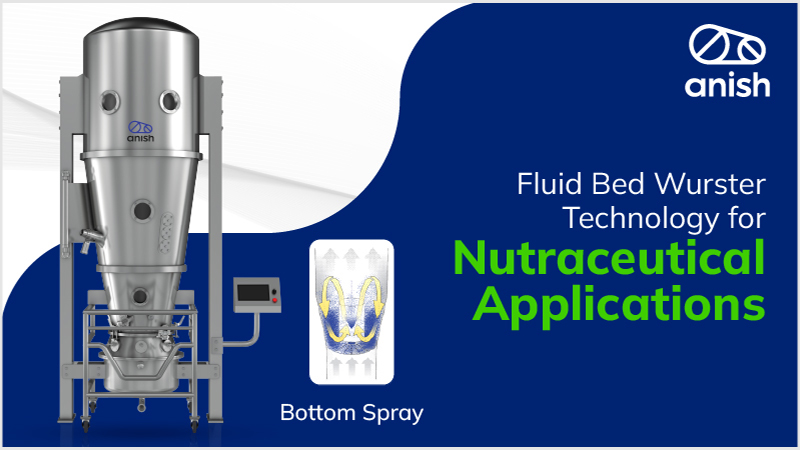
The nutraceutical industry is moving rapidly from conventional powders and blends to more advanced, stable, and consumer-friendly dosage formats. Ingredients such as vitamins, minerals, probiotics, herbal extracts, carotenoids, amino acids, enzymes, and functional actives are increasingly being used in tablets, capsules, sachets, gummies, beadlets, granules, and ready-to-mix formats.
However, many nutraceutical ingredients are sensitive to moisture, oxygen, heat, light, taste, odour, and processing conditions. This creates challenges in terms of stability, flowability, controlled release, taste masking, and final product performance. Fluid Bed Wurster technology plays an important role in overcoming these challenges.
What is Fluid Bed Wurster Technology?
Fluid Bed Wurster is a bottom-spray coating system used for precise and uniform coating of particles, pellets, granules, beads, crystals, and active ingredients. In this process, particles are fluidized using controlled air flow, while coating solution or suspension is sprayed from the bottom through a Wurster column.
This creates a controlled cyclic movement of particles, allowing each particle to receive a uniform coating layer. The process is widely used where consistent coating, accurate release profile, protection of actives, and batch-to-batch reproducibility are required.
Why Wurster Coating is Important for Nutraceuticals
Nutraceutical ingredients often need protection before they are converted into finished dosage forms. Wurster coating helps improve the performance of such ingredients by creating a functional barrier around the active material.
It can help protect sensitive actives from moisture, oxidation, heat, and interaction with other ingredients in the formulation. It can also help mask unpleasant taste or odour, improve flow properties, reduce dusting, and support controlled or delayed release.
Key Applications in Nutraceutical Manufacturing
Fluid Bed Wurster technology is useful in several nutraceutical applications:
- Taste Masking
Many nutraceutical actives have bitter, spicy, earthy, metallic, or unpleasant taste profiles. Wurster coating helps create a barrier between the active ingredient and the consumer’s taste perception. - Moisture and Oxygen Protection
Sensitive ingredients such as vitamins, probiotics, enzymes, carotenoids, and herbal extracts may degrade when exposed to moisture or oxygen. A protective coating helps improve stability during storage and processing. - Controlled Release
Some nutraceutical ingredients require delayed, sustained, or targeted release for better performance and user experience. Wurster coating helps achieve controlled release by using suitable coating materials and process parameters. - Improved Flowability and Handling
Fine powders can create handling, dusting, segregation, and dosing challenges. Coated particles and granules provide better flow, improved processability, and easier downstream manufacturing. - Ingredient Compatibility
In complex nutraceutical formulations, multiple actives are often combined. Coating can help reduce unwanted interaction between sensitive ingredients and improve formulation stability. - Premium Dosage Formats
Wurster-coated particles can be used in capsules, tablets, sachets, stick packs, beadlets, sprinkle formats, and functional food applications where uniformity and visual appeal are important.
Advantages of Fluid Bed Wurster System
A well-designed Fluid Bed Wurster system offers several advantages for nutraceutical manufacturers:
- Uniform and precise coating
- Better control over particle movement
- Suitable for functional coating and encapsulation
- Improved batch consistency
- Better protection of sensitive ingredients
- Reduced dust generation
- Improved product appearance and flowability
- Flexible application across multiple particle sizes and formulations
- Scalable from lab to production batches
Importance of Process Control
Wurster coating is a process-sensitive operation. Parameters such as inlet air temperature, product temperature, spray rate, atomization air pressure, fluidization air volume, coating solution concentration, and drying efficiency must be carefully controlled.
Improper control can lead to agglomeration, uneven coating, improper drying, poor yield, or inconsistent release profile. Therefore, equipment design, process know-how, automation, and application trials are critical for successful nutraceutical coating.
Role of Application Trials
Before investing in production-scale equipment, nutraceutical manufacturers often need to test their actual ingredients and formulations. Application trials help evaluate coating efficiency, product stability, particle behaviour, release profile, and process scalability.
Anish Pharma supports this approach through its Test–Evaluate–Acquire methodology, where customers can conduct trials at anish application lab using their own materials before finalizing the equipment. This helps reduce uncertainty and enables better decision-making.
As nutraceutical products become more advanced, ingredient performance can no longer depend only on the active compound. Stability, taste, flowability, release profile, and process compatibility are equally important.
Fluid Bed Wurster technology enables nutraceutical manufacturers to improve ingredient performance through precise coating and particle engineering. For companies looking to develop differentiated, stable, and consumer-friendly nutraceutical products, Wurster coating offers a practical and scalable solution.
Anish Pharma designs and manufactures advanced Fluidized Bed Systems, including Coaters and Wurster systems, for pharmaceutical, nutraceutical, and food applications. With strong process equipment expertise, application understanding, and manufacturing infrastructure, Anish delivers customized, reliable, and scalable solutions for modern manufacturing needs.
Other Blogs
- Ointment Manufacturing Plant for Pharmaceutical Production
- Liquid Manufacturing Plant for Pharmaceutical Production
- Fluid Bed Technology for Nutraceutical Ingredients
- Extruder & Spheroniser for Pharmaceutical Pelletisation
- API Reactor Charging Isolators: Improving Operator Safety During Reactor Charging
- Top Spray Fluid Bed Granulator
- Role of Isolators in Pharma Manufacturing
- Fluid Bed Coater for Pharma Manufacturing
- When Should You Retrofit Pharmaceutical Equipment?
- Top Challenges in Granulation Process and How to Solve Them
- Top 10 Pharmaceutical Equipment Used in Tablet & Capsule Manufacturing
- Things to Consider Before Buying Granulation Equipment
- Integrated Granulation Line (Closed Loop Granulation Line) in Pharmaceutical Manufacturing
- How Automation is Changing Pharmaceutical Manufacturing in India
- Fluid Bed Dryer vs Fluid Bed Coater
- Containment Systems in Pharma Manufacturing (OEB Levels Explained)
- Role of Preformulation Parameters in Pharmaceutical Dosage Forms Manufacturing
- Equipment Capacity and Airflow Management for Successful Fluid Bed Coating Scale-Up
- What is granulation? Why do we need it? And what’s the best place to carry it out?
- What is a Fluidized Bed Dryer?
- The Heart and Soul of the Pharmaceutical Industry: Materials & Machines
- Temperature and Humidity: Critical Factors in Fluid Bed Processing
- Mastering Pellets Manufacturing: The Role of QTPP and QbD
- Importance of Solvent Systems in Pharmaceutical Pellets Coating
- Guide to Optimal Fluid Bed Processor Selection: Key Considerations for Effective Material Processing
- Fluid Bed Performance Drivers
- Influence of Column Diameter and Partition Gap on Scale-Up of Bottom Spray Fluid Bed Coaters
- Critical Process Parameters Influencing Performance in Fluid Bed Systems
- Critical Factors for Scale-up in Bottom Spray Fluid Bed Coating
- Binders and Solvents in Granulation
- Types of Granulation in Pharma Manufacturing
- Granulation Techniques To Create Robust Formulation
- Unleashing the Power of Fluid Bed Technology: A Comprehensive Guide
- Pharmaceutical Pellet Production Techniques
- Pharma Granulation: From Powders to Perfect Granules
- Improving Productivity of Fluid Bed Processors
- Drug layering technique in pellet formation
- Drug delivery technologies in Pharmaceutical Formulations
- How to Choose the Right Pressure Shock Resistance (2 / 12 BAR) for Your Fluid Bed Processor